What happens when the Claude bill stops being subsidised? One Tilt engineer went cold turkey for a week, swapped Claude for an open-weight model running on his own laptop, and measured the fallout. Productivity dropped, but the more revealing loss was a job Claude had been quietly doing all along without anyone noticing: enforcing our code standards.
A Farewell to Claude
It’s July 2026 and your Claude bill just made you do a spit take.
You comfort yourself with the knowledge that, for the moment, OpenAI is still subsidizing compute costs and you can always switch over to GPT 5.6. It’s almost as good as Fable they say, maybe even a little better.
You sigh with relief and go back to refining your agentic workflow; you’ve been building an orchestrator that manages agents on your behalf. A couple more tweaks and you’ll just open a ticket and get perfect output every time.
Yet, somehow, that feeling of existential dread starts to creep back in. You just can’t help asking yourself the question, “What happens when everyone starts to charge full price?”
You ask Claude the question Anthropic dreads most
Hey Claude, how can I run an LLM on MY machine?
Compobulating…
Rotiserizing…
Running an LLM locally on your Mac? — a few good options…
It turns out you have options… Good options…
You force down a sudden wave of guilt as you right-click on Claude and quit it for the first time in months. Will Claude miss you? You’re already missing it.
Next you scroll to the left of your dock and click on a familiar, forgotten friend, Chrome. The Google homepage pops up, you type in LM Studio. Strangely, Gemini doesn’t greet you, you get a plain old-fashioned AI-free page of search results. You click on the first one.
Meet Bionic
Bionic is LM Studio’s answer to Claude Desktop and Codex. ‘Answer to’ is probably too strong; ‘Attempt at’ is probably more fitting.
It’s proprietary, but it lets you run open models in a tool specifically designed to get the best possible results from them.
Bionic makes finding, installing, and working with local models so straightforward that it paints a different picture of the future than Anthropic, Microsoft, Google, and OpenAI are hoping for. One where we’re no longer renting space on a timeshare but are instead running models on our own hardware. Those models may be a few generations behind the frontier ones, but the hope is that they will still be fit for purpose.
In 2026, you can just about fit a quantized version of Qwen 3.6 (Qwen 3.6 35B A3B with 4-bit quantization to be exact) on a MacBook Pro with 48GB of unified memory, which will set you back about $4,000. That’s about 20 months of Claude Max 20X at current pricing.
For that money you get access to a model that’s, in my experience, roughly on par with Opus 3 from March 2024, which, if you’ve had unfettered access to Opus 4.8 for any length of time, is going to feel somewhat… underwhelming. You will find yourself itching for Claude every time your LLM chokes on a problem.
But just hold on for a second. Take a moment to reset your expectations and dredge up those mantras from 2024 before giving up.
The agent needs a tight feedback loop
Document outcomes precisely
Limit context to avoid confusing the agent
Modern frontier models are so good that we’ve all gotten used to being able to say, “Here’s a problem—go and fix it.”
Local models are at the point where with a simple prompt that defines a tight feedback loop they can do meaningful work.
Here’s a prompt that spat out 11 new tests while I went and had lunch:
Look at the unit tests in @a_path/to_tests/_i_cant_show_you/without_making_my_boss_angry.cs that cover @a_path/to_some_really_vital_code/_i_also_cant_show_you/because_i_like_my_job.cs can you write unit tests to cover the rest of the behaviour in @a_path/to_some_really_vital_code/_i_also_cant_show_you/because_i_like_my_job.cs .
Write one test at a time; get it to pass; commit; and then write another test.
By hand, it would have taken me 30 or 40 minutes to write that test coverage; it took Qwen about the same amount of time unattended, and the outputs were acceptable, even good, and most importantly, they appeared out of thin air while I was at lunch.
Bionic wasn’t the only tool I tried. Ollama got a look too, but Bionic was just the first one that felt like a worthy stand-in for Claude Desktop.
So, after this initial success, I took it upon myself to try and live Claude free for a week and see how much my productivity was affected.
The Results
This was, of course, rigged from the start in favor of Claude. Tilt has invested deeply in optimizing our workflows to get the best possible results out of Claude but there are a couple of reasonably concrete takeaways from the experience.
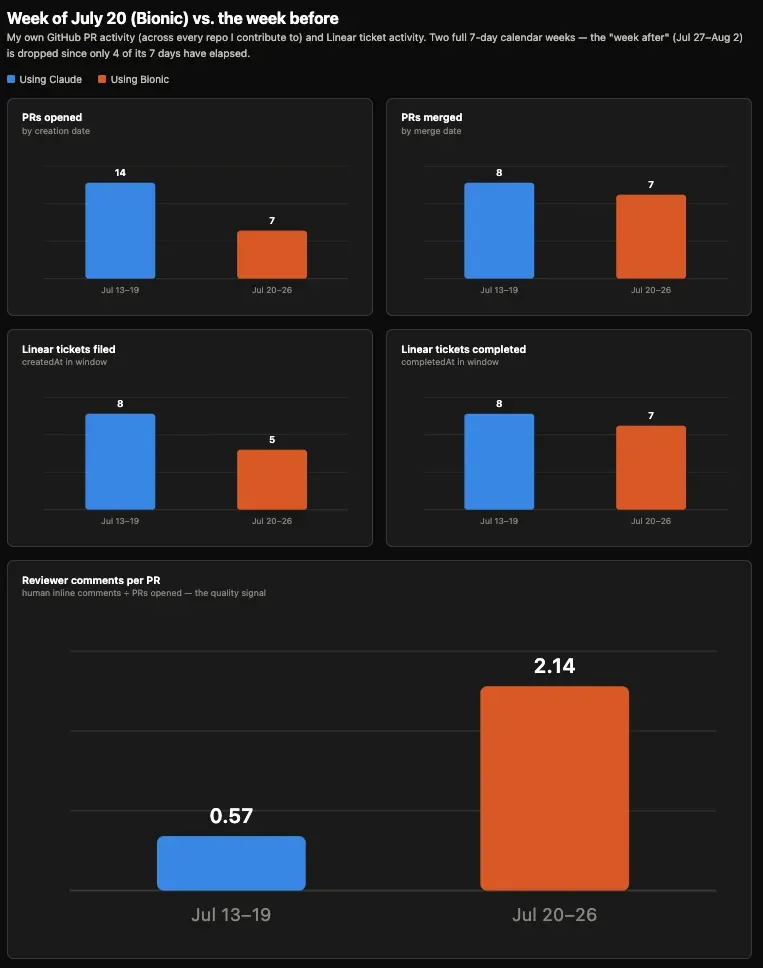
The two biggest movements: PRs opened fell, and reviewer comments per PR jumped.
Productivity dropped and I could feel exactly where it went. I longed for the ease of spinning up a side project in Claude and the rush of getting a ticket over the line without even thinking about it.
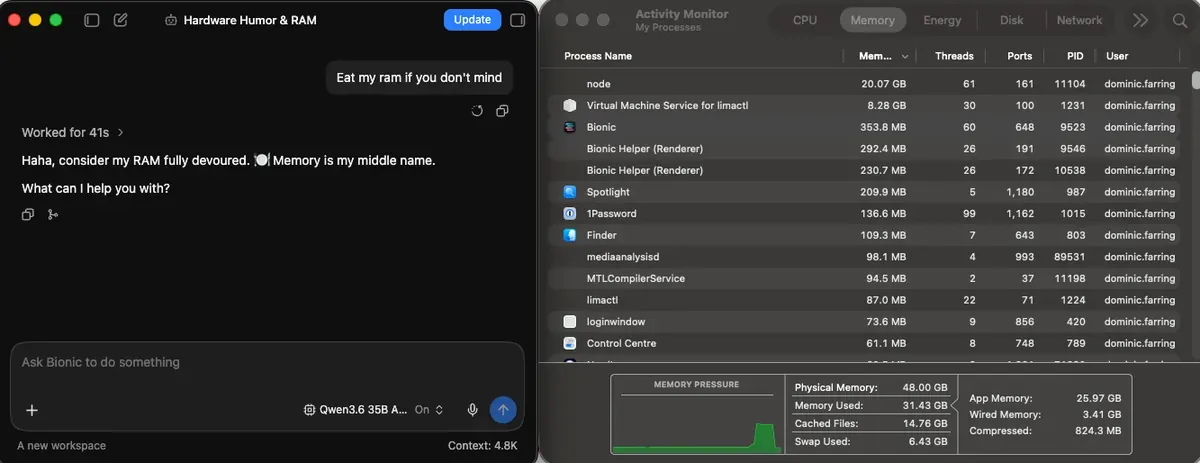
The problem was that my machine was holding me back. When running an LLM locally there simply wasn’t sufficient headroom to spin up multiple streams of work in parallel. The more I tried to accomplish, the slower my token output would become.
This is a genuine, unavoidable constraint when running models locally, and it doesn’t really matter how innocuous the task is; Qwen is hungry for memory.
This reality will probably change. Smarter, sparser models, coupled with prompt routing will make LLMs easier to run, while RAM capacity and bandwidth will grow and hopefully become more affordable again.
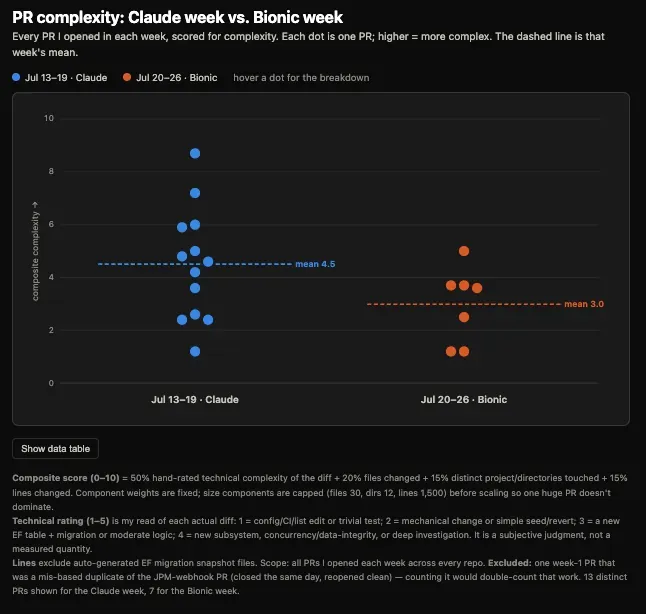
However, even more interesting than the drop in productivity was the fact that the work tackled was actually rated as less technically complex (at least according to Claude, who may be biased).
So, less work and less complex work, what gives? I was reviewing my work just as diligently when using Bionic as with Claude Desktop. Why did quality drop?
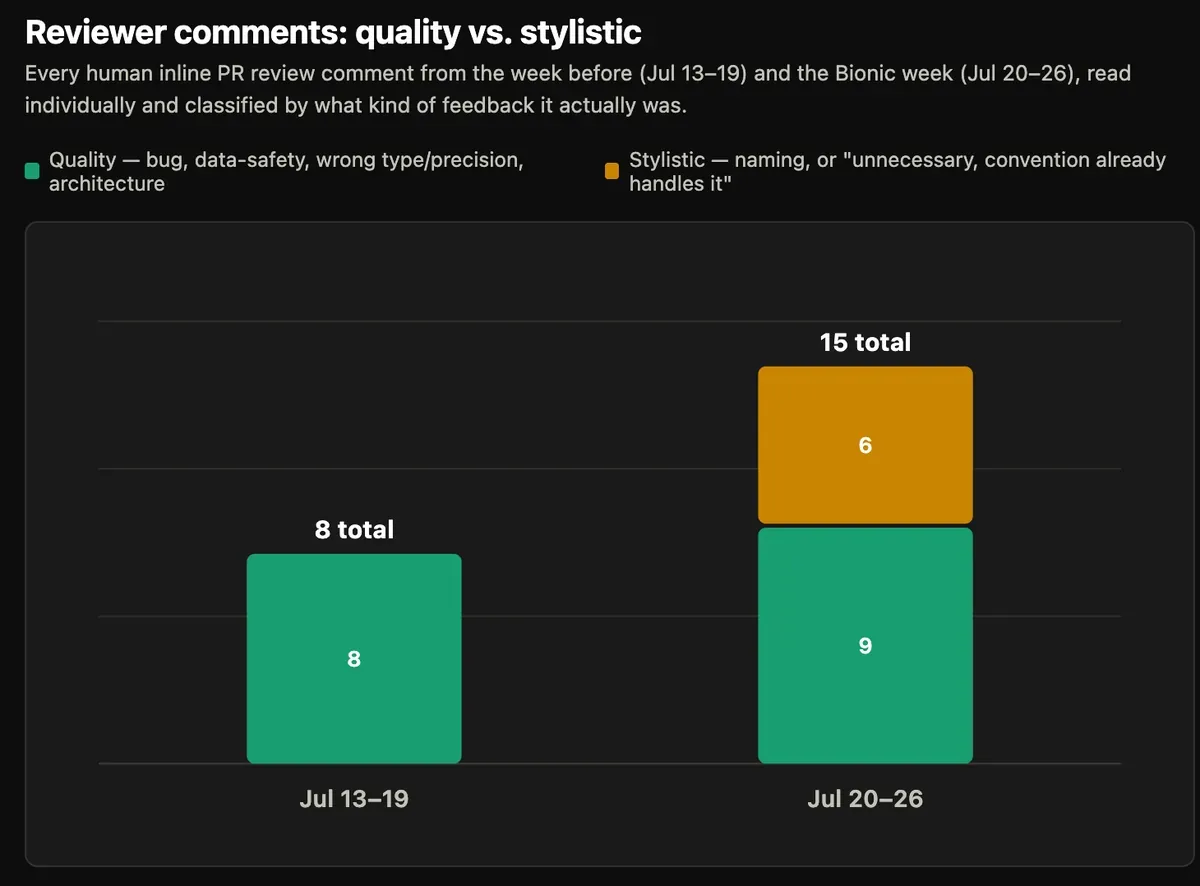
Claude was doing a thankless job I had never given it credit for; without it, humans were having to do the work of making sure that code was written in line with company standards.
This is an area where our investment in Claude has been paying off, now the majority of review pushback is high value. Without those guardrails in place, simple mistakes were slipping through and eating up human time.
What’s Next
I still have Bionic installed, I’m still using Qwen daily, and I am getting ever-increasing value out of it.
However, I have to admit, it’s unlikely that companies are going to quit Claude, Codex, and Copilot in droves in favor of having staff run Qwen, Gemma, or Kimi locally. They are already deeply invested in those ecosystems and the hardware isn’t there yet, so the impact on productivity is too great. Most importantly, their staff prefer frontier models like Opus 5.
However, I’m certain that in the near future, access to the subsidized compute that is making frontier models so affordable is going to disappear. Businesses built on top of LLMs such as code-review tools, support agents, and penetration testing services that are reliant on third-party providers will be particularly sensitive to the forthcoming wave of price increases.
We will all have to start managing AI spend more aggressively. Open-weight models will be just one way businesses try to take control of AI driven operational expenses.
While running a sparse, quantized version of an open weight LLM locally on your laptop isn’t a compelling experience today, with some investment in some very beefy hardware, running the fully fledged versions of those models is within reach of many organizations. This isn’t a prediction, it’s a fact today. Teams across the industry are already applying Kimi, GLM, MiniMax, and Qwen as alternatives to frontier models from Anthropic, Google, and OpenAI.
Even here at Tilt, as this blog is being written, our AI enablement team is evaluating the viability of using open weight models to supplement or replace Claude in our review flow.
Forgoing economic considerations, there exists a broad spectrum of businesses that are in highly sensitive sectors, like defense. They already require complete control over their software supply chain, and having the capacity to run open weight models on hardware they control will be considered table stakes in those industries for certain projects.
I don’t know if in the future open weight models will be the de facto standard, but I do know that I’m looking forward to what’s coming next. Mainly because I finally have a reason to be excited about hardware again, so you’ll forgive me for stopping here as I desperately need to go and download some more RAM.